The Mess That Makes and the Mess That Breaks
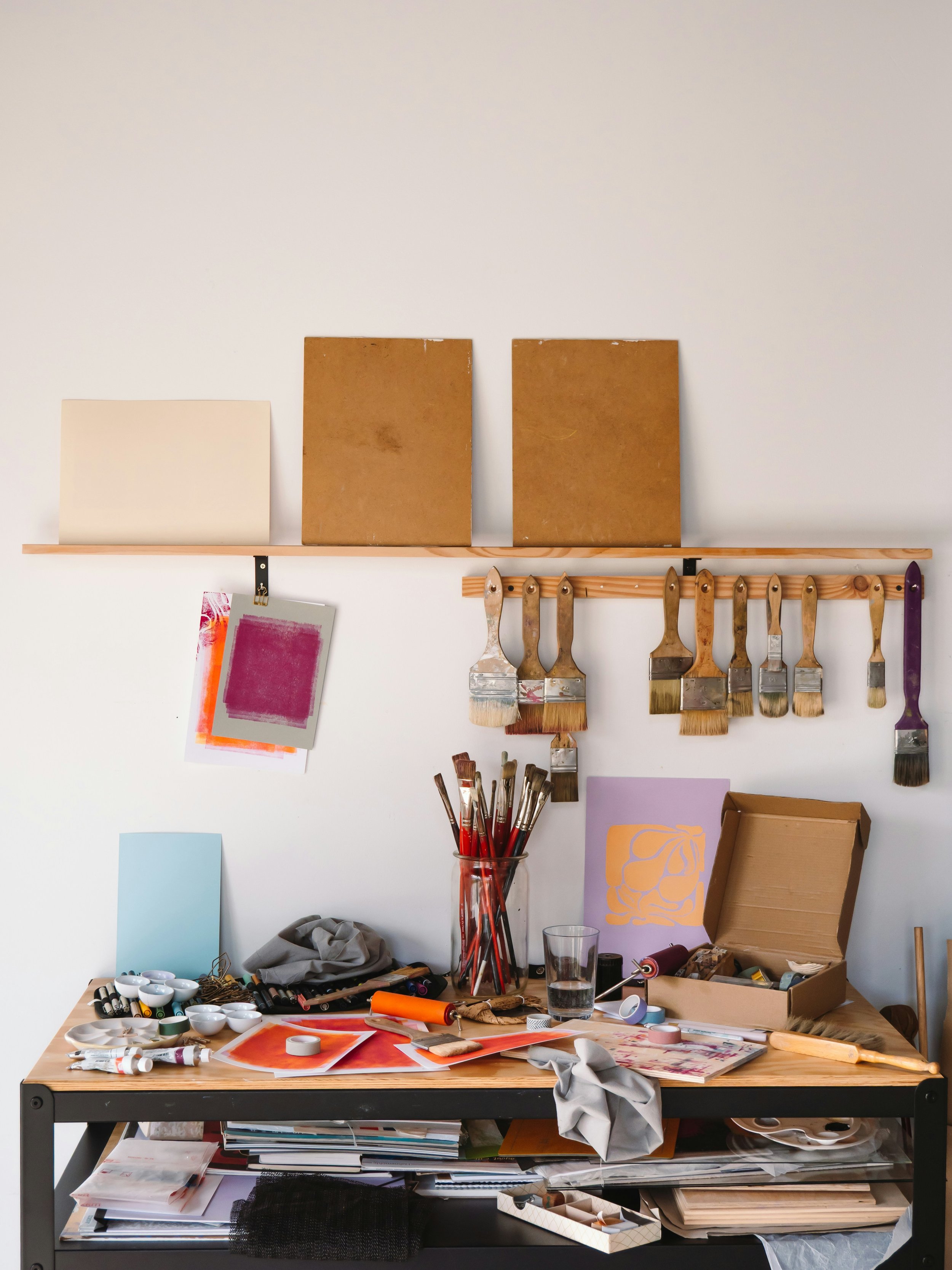
Creative Highlight - Photo by Paulina Herpel
So I've been thinking about this a lot lately. Especially where I am right now in life, existing in a live/work loft at this season in my life. AND I've been diving DEEP into neuroscience. It's pretty mind-blowing.
It's well-known that Albert Einstein kept a desk that looked like a paper avalanche mid-collapse. When someone pointed it out, he didn't apologize for it. He asked a question. "If a cluttered desk is a sign of a cluttered mind, of what, then, is an empty desk a sign?"
WOW. Right? Talk about a major moment in perspective.
It IS a great line. And crazy enough, it's also been studied scientifically. A study published in Psychological Science found that people working in messy environments actually scored higher on creative thinking than people working in tidy ones. Whhhaaaaa?! It turns out, mess makes us brave. Order makes us cautious.
So… mess equals creativity. Great. Except that's only one side of looking at it.
Because at the same time, neuroscientists at Princeton found something that contradicts it: clutter competes for your brain's attention. Every object in your visual field (peripherals included) that isn't the thing you're trying to focus on is quietly fighting for processing power. The result isn't creative liftoff. It's cognitive drag! Lower focus. Higher stress. A visual cortex running its own background noise underneath everything you're trying to focus on.
So which is it? Is mess the thing that inspires us, or the thing quietly wearing us down?
It's not a contradiction. It's a rhythm.
Because the mess Einstein was sharing wasn't stagnant — it was the result of his expansion. It's what a workspace looks like mid-idea, when you're pulling everything out, following tangents, letting things overlap because you don't know yet which connection matters. You should see the amount of post-its I go through… eeeek! That kind of mess is generative. It's supposed to be there. It means something is actively being built, and it helps us see things more clearly sometimes. That's why I keep everything visible — the second an idea goes out of sight, it goes out of mind.
The clutter the neuroscientists were studying is different. It's a mess that's stopped moving. Mess that's overstayed its welcome. The unfinished pile that used to represent an open idea and now just represents an open loop your brain can't close.
This repeating cycle and loop will continue for as long as we allow it to.
Which brings us to the difference. It isn't mess versus order. It's expansion versus retention.
It's funny. Once you start looking, this same rhythm shows up in almost every book on process and habit-building out there. You open wide to generate, and then you close in to collect. You scatter, and then you gather. Imagine the rhythm of our breathing. The tide coming in and going out. Repetition and expansion is where rhythm lives.
The creative process isn't one gesture. It's two, bouncing back and forth between each other. And the trouble starts when we get stuck in only one of them — expanding forever without ever circling back to collect what we made, or clinging so hard to tidiness that we never let ourselves make the mess required to find something new.
So maybe the real skill isn't choosing between the tidy desk and the cluttered one. It's knowing where you are in your creative process, and understanding which one feels right in the moment — and trusting yourself enough to move into the other one when it's time.
Retracting and expanding. Then pulling it back in close again.